
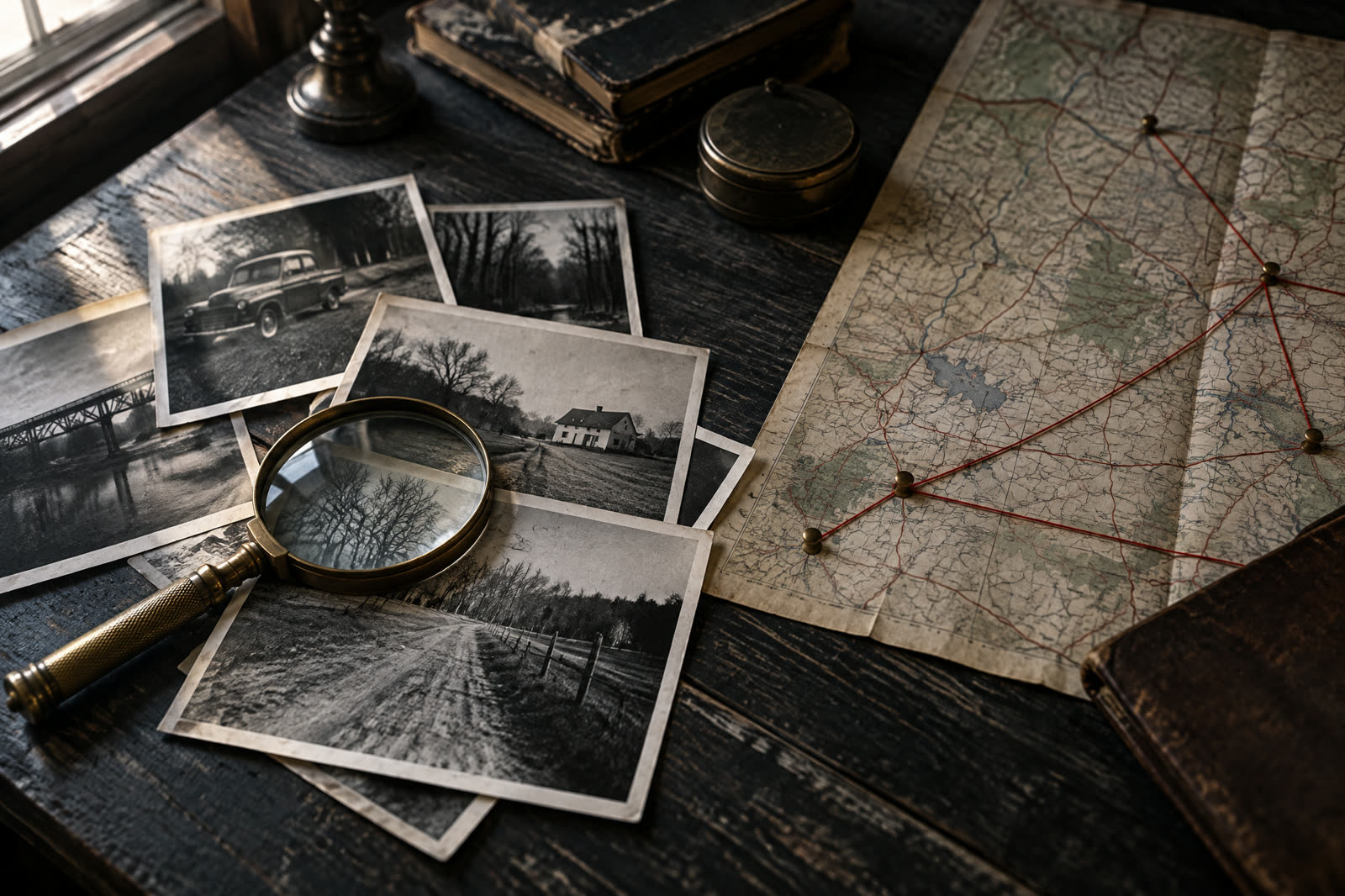
A photograph becomes an exhibit the moment someone can testify to what it shows, when it was taken, and why it fairly represents the scene — and not one moment before. Plenty of case files hold a hundred pictures and no exhibits. The difference is not the camera. It is the discipline wrapped around it, and the discipline exists because every frame is taken for an audience of one: the opposing professional who will be paid to ask what the picture conveniently leaves out.
The album problem
Untrained scene photography has a recognizable style: dramatic close-ups of the interesting thing, shot from the angle that makes the point best, at whatever time the photographer happened to arrive. It looks persuasive in a conference room. In a courtroom it invites three questions that have no good answers. Where is this in relation to anything? What did the rest of the scene look like? And why does every frame happen to favor your client?
The album documents what the photographer found interesting. The file documents the scene. Those are different assignments, and the second one includes the parts that cut the wrong way — because if the unhelpful angle exists, better that the defense has it, knows it, and built around it than that it arrives mid-trial as a surprise.
Sequence and scale
Courtroom-grade documentation moves like a funnel: establishing shots that place the scene in its surroundings, mid-range shots that place each feature within the scene, close-ups that show the detail — each one locatable inside the one before it. A close-up that cannot be placed is an orphan; a jury has no idea what it is looking at, and opposing counsel will be happy to suggest possibilities.
Scale and orientation ride along: a reference for size where size matters, and enough context in frame that the geometry of the scene — distances, heights, angles — can be reconstructed rather than asserted. If a measurement matters, it gets measured, not estimated from a photo later. The photographs illustrate the measurements; they do not replace them.
Light is a fact of the case
If the event happened at 9:40 on a November night, the scene at noon in July is a different scene. What a witness could see — across a parking lot, through a windshield, from a porch — is governed by light, weather, foliage, and the exact position of a streetlamp, and all of those are documentable facts. Photographing at the matching time of day, in comparable conditions, is routine in this work and routinely decisive: the confident identification made from a spot where, at the relevant hour, a face is a shape, reads differently once the court sees the darkness itself.
Seasons count too. Southern Oregon brush grows fast and gets cleared faster; the sightline that existed in March is gone by August, in either direction. Scenes change — fences go up, businesses close, intersections get re-striped — which is why scene work belongs at the front of an engagement, not the end. A photograph of the corner as it was that night is only available while the corner cooperates.
The log is half the exhibit
Every image carries data, and the file carries more: when each frame was taken, where, by whom, facing which direction, under what conditions, with what equipment. Modern cameras embed much of this; the investigator’s log records the rest, including the things no camera knows — why this location, what was moved (nothing, ideally), who else was present. Originals are preserved unedited; anything enhanced for clarity is labeled as a copy and the original stays in the file.
None of this is ceremony. It is the testimony, pre-written. The investigator who takes the stand to authenticate a photograph is really testifying to the log — and a log kept the same careful way on every matter is the quiet answer to the standard attack, which is never “is this photo fake” but “can you really say, two years later, when and where this was taken.” Yes. It’s written down.
Return trips and the changed scene
Sometimes the scene has already changed by the time the defense arrives — the brush is cleared, the camera housing is down, the skid marks are a winter old. The documentation assignment changes with it: photograph what remains, document what changed and when, and gather the earlier state from whoever has it — the business’s own footage, the county’s road records, the real estate listing from two years ago with the fence line visible. Proving what a place used to look like is slower than photographing it, which is one more argument the calendar always makes for itself.
One discipline, both dockets
Everything above serves criminal defense investigation, where scene facts test witness accounts and official narratives. The identical discipline serves civil defense matters — the premises claim, the collision, the property dispute — where the opposing carrier photographed the scene within days and the defense should not be reconstructing it from memory a year later. In both arenas the standard is the same: every frame, log entry, and measurement built to hold up when tested by someone whose job is to make it fall down.
If a scene in a pending matter hasn’t been documented — or is about to stop existing — the conversation costs nothing.